The 2026 List Industry Icons
Navflex
Navflex Named a 2026 Industry Icon in AI & Robotics
Recognized for developing autonomous mobile robots that bring flexible, AI-guided material handling to warehouses and manufacturing facilities without requiring fixed infrastructure.
navflex.com/
Recognized for bringing Physical AI to one of logistics’ hardest environments: the loading dock, where autonomous mobile robots must understand changing trailers, imperfect pallets, people, forklifts, and real-world conditions in real time.
Navflex has been selected as a 2026 Industry Icon in AI & Robotics by The 2026 List, brought to you by Industry & Influence, recognizing the company’s work in autonomous trailer loading and unloading, adaptive warehouse robotics, and a 2026 partnership designed to bring its technology to industrial scale.
Warehouse automation is easiest when the environment can be controlled.
The loading dock is the opposite.
Trailers vary.
Pallets shift.
Floor conditions change.
People and manual forklifts move through the same space.
Loads arrive imperfectly aligned and every facility has different constraints.
Navflex built its robotics platform around that messiness.
Automating the Hardest Part of the Warehouse
Many warehouse technologies automate highly structured processes.
Conveyors follow fixed paths.
Automated storage systems operate within carefully defined geometry.
Traditional robots perform best when the world around them is predictable.
Trailer loading and unloading is more difficult because the environment changes continuously.
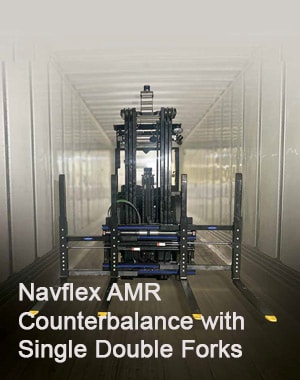
Navflex’s AI-powered autonomous mobile robots are designed to load and unload trailers without requiring the dock to be rebuilt around the robot.
That is a meaningful distinction.
The technology has to adapt to the warehouse rather than forcing the warehouse to become a robotics lab.
Physical AI Instead of Fixed Automation
Navflex describes its approach through the language of Physical AI.
The concept combines perception, autonomy, and process intelligence so machines can understand what is happening in a real physical environment and respond appropriately.
That makes the robot’s job more complex than following a pre-programmed route.
It has to recognize pallets, understand open space, account for people and vehicles, navigate changing trailer conditions, and make decisions in real time.
The objective is practical autonomy.
A system that only works when every pallet and trailer is perfect solves a demonstration problem.
A system that works around everyday warehouse variability solves an operating problem.
Safety Is Part of the Value Proposition
The loading dock is also one of the more hazardous areas in a warehouse.
Workers move heavy pallets in confined spaces while interacting with trailers, forklifts, dock equipment, and tight schedules.
Navflex positions automation partly around reducing exposure to that work.
Its robots are designed to operate alongside humans and manual forklifts while taking on repetitive loading and unloading tasks.
That creates a potential safety benefit alongside the productivity case.
The most valuable industrial robots often do both.
They improve throughput while moving people away from the most physically demanding or risky parts of the process.
Hours, Not Months
Industrial automation projects can become expensive before they create value.
Integration, infrastructure changes, programming, commissioning, and training can stretch deployments over months.
Navflex emphasizes rapid deployment, saying its systems can be operating in hours rather than weeks or months.
That speed is strategically important.
A lower implementation burden can make robotics accessible to facilities that would not justify a massive fixed-automation project.
It also makes it easier to pilot technology against real operating conditions before committing to a wider rollout.
A Global Partnership for Scale
In July 2026, Navflex CEO Chuck Stovall described the company’s partnership with Jungheinrich as an important step in the development of autonomous logistics.
The relationship combines Navflex’s work in perception, autonomy, and process intelligence with Jungheinrich’s vehicle platforms, industrial expertise, global service network, and scale.
That partnership addresses a common robotics challenge.
A strong autonomy system is only one part of a commercial product.
Customers also need rugged hardware, deployment support, service, parts, and confidence that the system can be supported across large operations.
Pairing robotics intelligence with an established material-handling organization can accelerate the path from innovative system to dependable industrial platform.
The Dock as a New Automation Frontier
As warehouses automate picking, storage, movement, and sorting, the loading dock increasingly becomes a remaining bottleneck.
It is also the transition point between the controlled warehouse and the less controlled transportation network.
That makes it strategically important.
Every delay at the dock affects trailer turns, labor, yard operations, and downstream schedules.
Navflex is focused precisely on that handoff.
If autonomous systems can perform reliably there, one of logistics’ most stubborn manual processes becomes part of the connected automated warehouse.
Why Navflex is a 2026 Industry Icon
The 2026 Industry Icon designation recognizes organizations demonstrating meaningful innovation, leadership, momentum, industry impact, and the ability to influence what comes next within their respective fields.
Navflex was selected for applying adaptive AI and robotics to a warehouse environment that has historically resisted automation.
Its focus on real-world variability, rapid deployment, safety, autonomous trailer handling, and its partnership with Jungheinrich demonstrate a company moving from a difficult technical problem toward scalable industrial adoption.
For its work in Physical AI, loading-dock automation, warehouse safety, and the next generation of autonomous logistics, Navflex has been selected as a 2026 Industry Icon in AI & Robotics.
Explore Navflex
Explore all 100 Industry Icons
View All Honorees